“Adopted by Blood” Registration
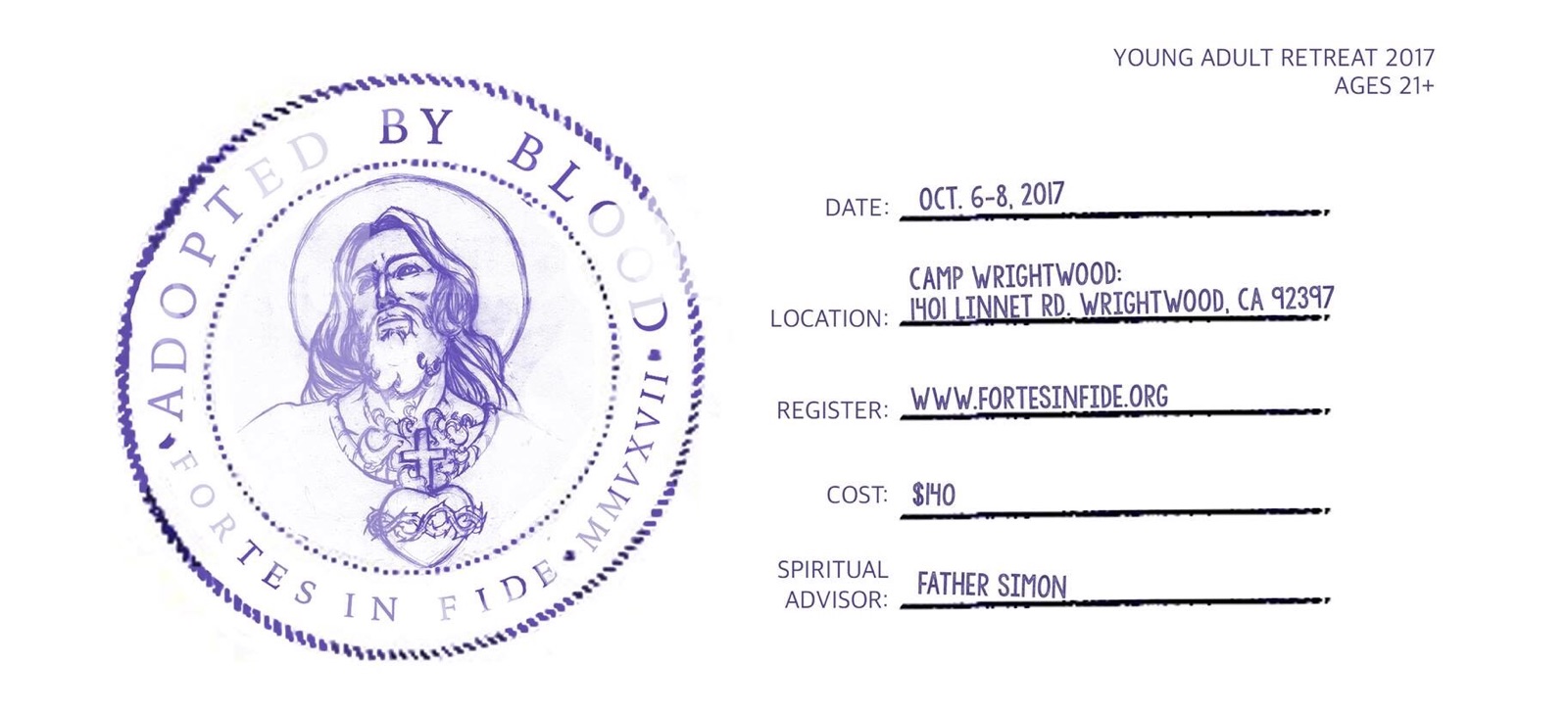
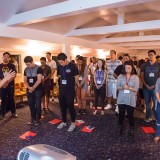
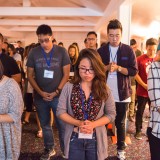
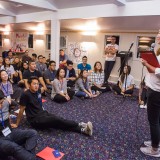
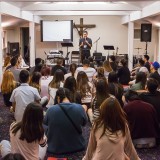
Register for 2017 Fortes in Fide young adult retreat “Adopted by Blood” as soon as possible to save a spot for yourself or a friend. Use online registration or submit a printed registration to your parish representative. Payments can be made in cash, check, or Venmo.
Registering In Person:
Please download the retreat registration form below, print a copy, fill it out completely, sign it, and submit along with payment to your parish representative.
2017 Fortes in Fide “Adopted by Blood” Retreat Registration Form (PDF) 
Retreat Parish Representatives
St. Basil, St. Gregory, St. Agnes, St. Paul
Jennifer Chung (jenn.ch.09@gmail.com)
KMCC, OLOP, San Diego
Grace Choi (deargracechoi@gmail.com)
St. Thomas, St. Andrew, St. Gabriel
Andy Park (apark23@gmail.com)
St. Raphael, St. Joseph
Elliot Lee (elee6tring@gmail.com)
103 Saints, St. Francis
Chris Choi (cjchoi24@gmail.com)
SungSam, St. Matthew
Veronica Kim (veronicayjk@gmail.com)
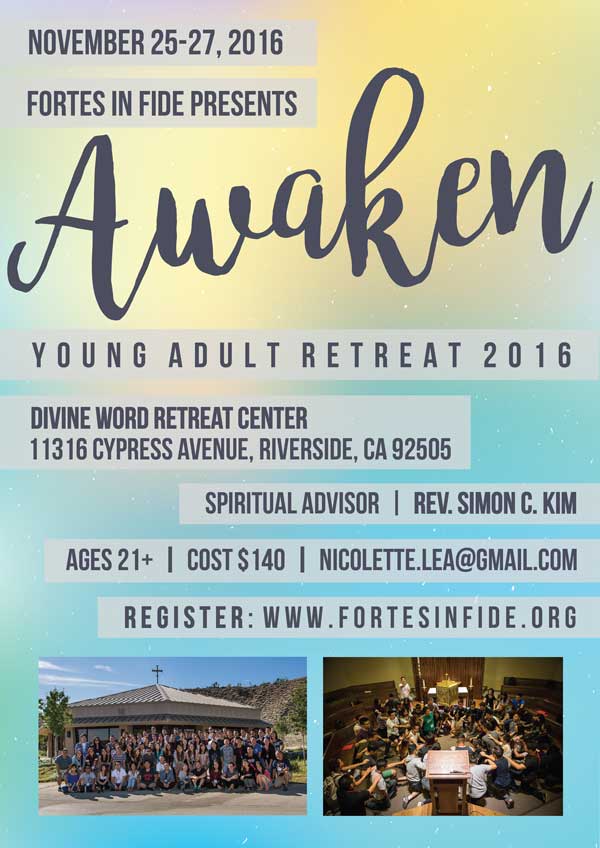
Register for this year’s Fortes in Fide young adult retreat “Awaken” as soon as possible to save a spot for yourself or a friend.
[su_button url=”https://goo.gl/forms/1fW0ZVK7281zHVSy2″ style=”flat” size=”12″ center=”yes” radius=”5″]Register Online[/su_button]
Registering In Person:
Please download the retreat registration form below, print a copy, fill it out completely, sign it, and submit along with payment to your parish representative.
2016 Fortes in Fide “Awaken” Retreat Registration Form (PDF)
Registration forms and payment are DUE by Sunday, November 20th, 2016.
Retreat Parish Representatives
St. Paul, St. Basil, St. Agnes, St. Gregory
Boyoung Kim (boyoung.kim88@gmail.com)
St. Raphael, St. Columba, San Diego
Veronica Kim (veronicayjk@gmail.com)
St. Matthew, Sungsam, NorCal, St. Andrew Kim (San Bernardino diocese)
Hyun Choi (gabriel.choi91@gmail.com)
St. Christopher, Our Lady of Peace
Sally Yu (sallyyu1021@gmail.com )
St. Joseph, St. Paul (Mission Hills)
Brian Yoo (commit2apply@yahoo.com)
St. Gabriel
Mindy Lee (mindy.lee1130@gmail.com)
103 Saints
Patrick Song (patrick.jk.song@gmail.com)
Grace Choi (deargracechoi@gmail.com)
St. Francis
Grace Choi (deargracechoi@gmail.com)
St. Thomas
Patrick Song (patrick.jk.song@gmail.com)
Helena Yoon (helenayoon27@gmail.com)
Korean Martyrs Catholic Center
Christina Yoon (cyoon426@gmail.com)
Grace Choi (deargracechoi@gmail.com)
Nicolette Lea (nicolette.lea@gmail.com)






















 ]]>
]]>































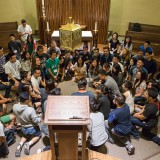
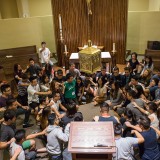
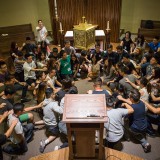
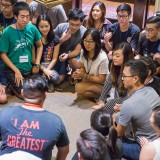




 ]]>
]]>













































 ]]>
]]>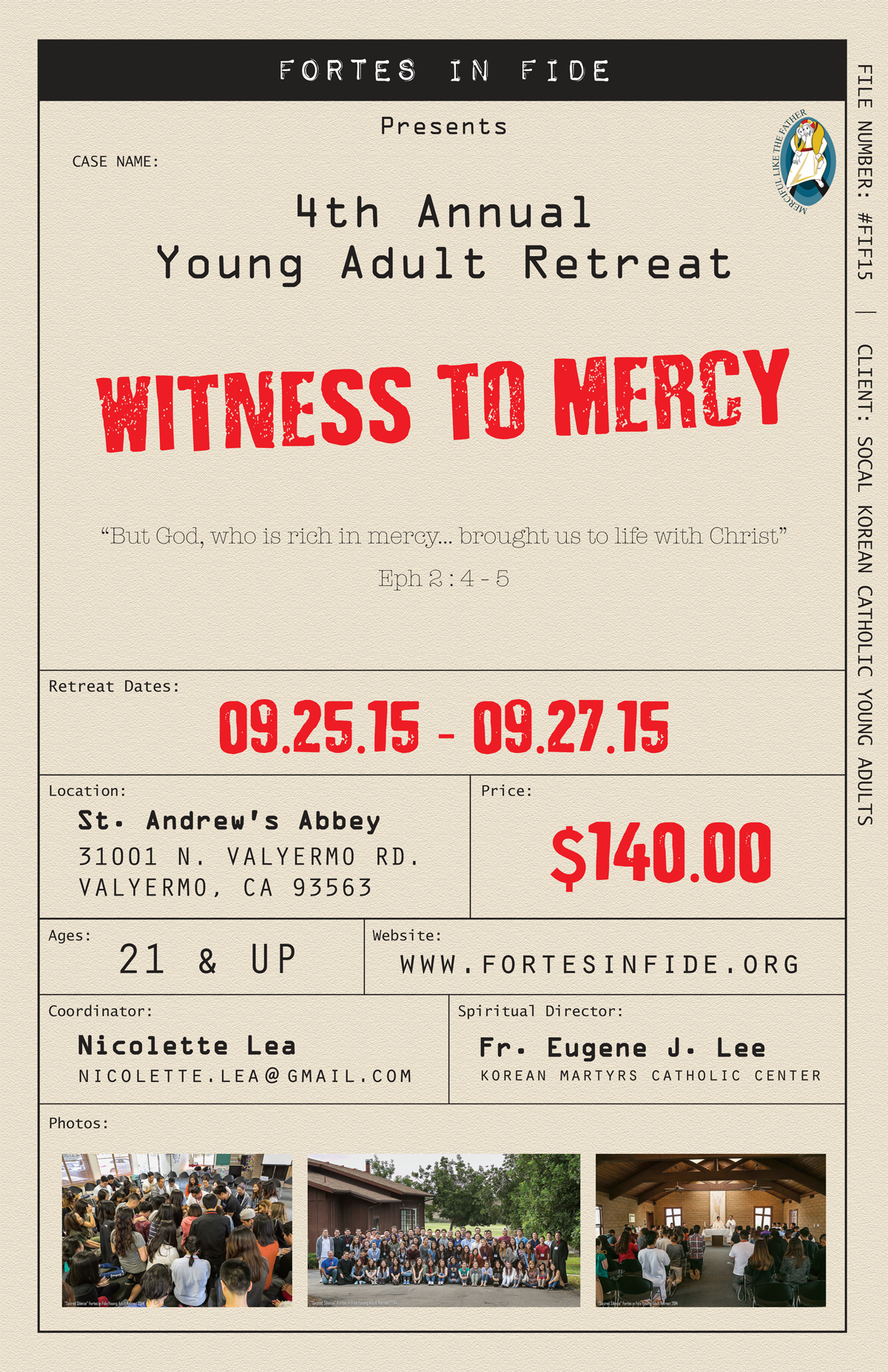
Please download the retreat registration form below, print a copy, fill it out completely, sign it, and submit along with payment to either your parish representative or mail to Nicolette Lea.
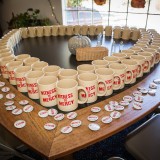
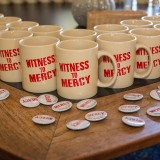
2015 Fortes in Fide “Witness to Mercy” Registration Form (PDF)
Registration forms and payment are due by Sunday, September 20th, 2015.
Registration Parish Representatives
St. Gabriel Korean Catholic Center
Sally Yu (sallyyu1021@gmail.com)
St. Raphael Catholic Church
Veronica Kim (veron1cak1m@yahoo.com)
St. Basil Catholic Church
David Moon (dmoonit@gmail.com)
St. Gregory Nazianzen Catholic Church
Paul Yoon (paulyoon915@gmail.com)
St. Joseph Korean Catholic Center
Alice Chon (a.k.chon@gmail.com)
St. Thomas Korean Catholic Center
Dave Kim (davewkim@gmail.com)
Korean Martyrs Catholic Center
Nicolette Lea (nicolette.lea@gmail.com)
[su_column size=”1/2″ center=”yes”]
[su_note note_color=”#ffffff00″ class=”shadow-box”]
A Guide to Confession
How to Go to Confession
1. You always have the option to go to confession anonymously, that is, behind a screen or face to face, if you so desire.
2. After the priest greets you in the name of Christ, make the sign of the cross. He may choose to recite a reading from Scripture, after which you say: “Bless me Father for I have sinned. It has been (state how long) since my last confession. These are my sins.”
3. Tell your sins simply and honestly to the priest. You might even want to discuss the circumstances and the root causes of your sins and ask the priest for advice or direction.
4. Listen to the advice the priest gives you and accept the penance from him. Then make an Act of Contrition for your sins.
5. The priest will then dismiss you with the words of praise: “Give thanks to the Lord for He is good.” You respond: “For His mercy endures forever.” The priest will then conclude with: “The Lord has freed you from your sins. Go in peace.” And you respond by saying: “Thanks be to God.”
6. Spend some time with Our Lord thanking and praising Him for the gift of His mercy. Try to perform your penance as soon as possible.
Prayer Before Confession
O most merciful God! Prostrate at your feet, I implore your forgiveness. I sincerely desire to leave all my evil ways and to confess my sins with all sincerity to you and to your priest. I am a sinner, have mercy on me, O Lord. Give me a lively faith and a firm hope in the Passion of my Redeemer. Give me, for your mercy´s sake a sorrow for having offended so good a God. Mary, my mother, refuge of sinners, pray for me that I may make a good confession. Amen.
Act of Contrition
Oh my God, I am sorry for my sins with all my heart. In choosing to do wrong and failing to do good, I have sinned against you whom I should love above all things. I firmly intend, with your help, to do penance, to sin no more, and to avoid whatever leads me to sin. Our Savior Jesus Christ suffered and died for us. In His name, my God, have mercy. Amen.
[/su_note]
[/su_column]
[/su_row]
]]>[su_column size=”1/2″ center=”yes”]
[su_note note_color=”#ffffff00″ class=”shadow-box”]
Examination of Conscience
1. I am the Lord your God. You shall not have strange gods before me.
– Do I give God time every day in prayer?
– Do I seek to love Him with my whole heart?
– Have I been involved with superstitious practices or have I been involved with the occult?
– Do I seek to surrender myself to God´s word as taught by the Church?
– Have I ever received communion in the state of mortal sin?
– Have I ever deliberately told a lie in Confession or have I withheld a mortal sin from the priest in confession?
– Are there other “gods” in my life? Money, Security, Power, People, etc.?
2. You shall not take the name of the Lord your God in vain.
– Have I used God´s name in vain: lightly or carelessly?
– Have I been angry with God?
– Have I wished evil upon any other person?
– Have I insulted a sacred person or abused a sacred object?
3. Remember to keep holy the Lord´s Day.
– Have I deliberately missed Mass on Sundays or Holy Days of Obligation?
– Have I tried to observe Sunday as a family day and a day of rest?
– Do I do needless work on Sunday?
4. Honor your father and your mother.
– Do I honor and obey my parents?
– Have I neglected my duties to my spouse and children?
– Have I given my family good religious example?
– Do I try to bring peace into my home life?
– Do I care for my aged and infirm relatives?
5. You shall not kill.
– Have I had an abortion or encouraged or helped anyone to have an abortion?
– Have I physically harmed anyone?
– Have I abused alcohol or drugs?
– Did I give scandal to anyone, thereby leading him or her into sin?
– Have I been angry or resentful?
– Have I harbored hatred in my heart?
– Have I engaged, in any way, in sins against human life such as artificial insemination or in vitro fertilization?
– Have I participated in or approved of euthanasia?
6. You shall not commit adultery.
– Have I been faithful to my marriage vows in thought and action?
-Have I engaged in any sexual activity outside of marriage?
-Have I used any method of contraception or artificial birth control in my marriage?
-Has each sexual act in my marriage been open to the transmission of new life?
-Have I been guilty of masturbation?
-Do I seek to control my thoughts and imaginations?
-Have I respected all members of the opposite sex, or have I thought of other people as mere objects?
-Do I seek to be chaste in my thoughts, words, actions?
-Am I careful to dress modestly?
7. You shall not steal.
– Have I stolen what is not mine?
– Have I returned or made restitution for what I have stolen?
– Do I waste time at work, school, and home?
– Do I gamble excessively, thereby denying my family of their needs?
– Do I pay my debts promptly?
– Do I seek to share what I have with the poor?
– Have I cheated anyone out of what is justly theirs, for example creditors, insurance companies, big corporations?
8. You shall not bear false witness against your neighbor.
– Have I lied? Have I gossiped?
– Do I speak badly of others behind their back?
– Am I sincere in my dealings with others?
– Am I critical, negative or uncharitable in my thoughts of others?
– Do I keep secret what should be kept confidential?
– Have I injured the reputation of others by slanders?
9. You shall not desire your neighbor´s wife.
– Have I consented to impure thoughts?
– Have I caused them by impure reading, movies, television, conversation or curiosity?
– Do I pray at once to banish impure thoughts and temptations?
– Have I behaved in an inappropriate way with members of the opposite sex: flirting, being superficial, etc.?
10. You shall not desire your neighbor´s goods.
– Am I jealous of what other people have?
– Do I envy the families or possessions of others?
– Am I greedy or selfish?
– Are material possessions the purpose of my life?
[/su_note]
[/su_column]
[/su_row]
]]>[su_column size=”1/2″ center=”yes”]
[su_note note_color=”#ffffff00″ class=”shadow-box”]
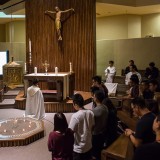
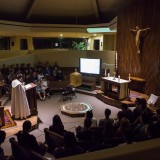
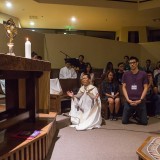
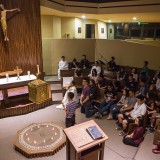
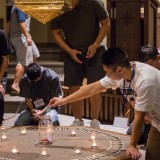
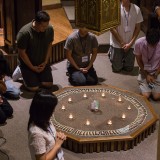
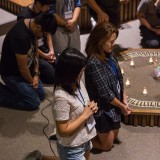
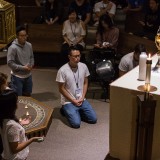
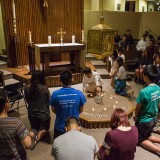
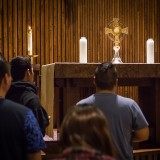
What is Eucharistic Adoration?
The Eucharist is the sacrament that Jesus established when He took bread and wine, blessed them, and declared them to be His body and blood (see Luke 22:17-20). He commanded His disciples to “Do this in memory of me.” He had earlier foretold that His presence in the Eucharist would be real and substantial: “I am the living bread that came down from heaven; whoever eats this bread will live forever … Whoever eats my flesh and drinks my blood has eternal life, and I will raise him on the last day. For my flesh is true food, and my blood is true drink” (John 6:51, 54-55). When a Catholic priest follows this command of Jesus and offers the words of consecration, the bread and wine are permanently changed, and they become Jesus: his body, blood, soul, and divinity.
How long is Jesus present in the sacrament of the Eucharist?
Jesus is present in the sacrament permanently. His presence is abiding, not something that vanishes at the conclusion of Mass. The hosts remaining after Communion are kept in a special place of honor called the tabernacle. [CCC 1377, 1379]
What is the relationship of Eucharistic adoration to the Mass?
The celebration of the Mass is the origin and purpose of the worship shown to the Eucharist outside the Mass. Eucharistic adoration extends Holy Communion in a lasting way even as it prepares the faithful to participate more fully in the celebration of the Mass. It leads us to acknowledge Christ’s marvelous presence in the sacrament and invites us to deeper spiritual union with Him in the reception of Holy Communion.
What is the importance of Eucharistic adoration?
Eucharistic adoration is the respect and worship we give to Jesus, who is truly present to us under the appearance of bread and wine. The Eucharist is a priceless treasure; by not only celebrating it but also by praying before it outside of Mass we are enabled to make contact with the very wellspring of grace. As St. Alphonsus Liguori noted, “of all devotions, that of adoring Jesus in the Blessed Sacrament is the greatest after the sacraments, the one dearest to God and the one most helpful to us.” [CCC 1418]
What is exposition of the Blessed Sacrament?
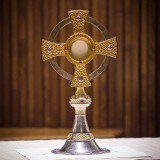
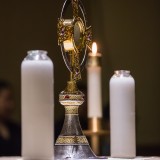
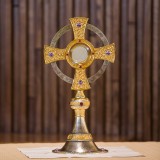
Exposition is the placement of the sacred host outside the tabernacle for public adoration. This can take many forms. The simplest form is the opening of the tabernacle doors. Another form is the removal of the sacred vessels from the tabernacle for a more prominent and visible placement. The Church also permits a “full” exposition, when the sacred host is clearly visible in a vessel called a “monstrance.”
What is the purpose of exposition of the Blessed Sacrament?
There are three purposes of Eucharistic exposition: (1) to acknowledge Christ’s marvelous presence in the sacrament; (2) to lead us to a fuller participation in the celebration of the Eucharist, culminating in Holy Communion; and (3) to foster the worship which is due to Christ in spirit and in truth.
What are the fruits of Eucharistic adoration?
People who observe Eucharistic adoration experience a deeper devotion to Jesus, and this manifests itself in countless ways. The primary fruits are repentance and conversion which lead to increased charity – that is, the love of Christ alive in His people. The adoration of Jesus in the Eucharist also leads to greater reverence at Mass, a deeper desire for personal holiness, and a stronger sense of union with the parish and the whole Church. Ever since the early centuries of Christianity, the Church has linked Eucharistic devotion to service to the poor. More recently, the practice has led to an increase in vocations to the priesthood, diaconate and religious life.
How should we pray during Eucharistic adoration?
There are many ways to pray. We may meditate silently by gazing on the sacred host. We may silently speak to Jesus from our mind and heart. We may also rely on devotions and prayers from Catholic tradition, such as the reading of Scripture, recitation of the rosary, or the litanies. When two or more are gathered before the Sacrament, they may pray or sing hymns together.
[/su_note]
[/su_column]
[/su_row]
]]>[su_column size=”1/2″ center=”yes”]
[su_note note_color=”#ffffff00″ class=”shadow-box”]
“MESSAGE OF POPE FRANCIS FOR THE 51st WORLD DAY OF PRAYER FOR VOCATIONS”
Dear Brothers and Sisters,
1. The Gospel says that “Jesus went about all the cities and villages… When he saw the crowds, he had compassion for them, because they were harassed and helpless, like sheep without a shepherd. Then he said to his disciples, ‘The harvest is plentiful, but the labourers are few; pray therefore the Lord of the harvest to send out labourers into his harvest’” (Mt 9:35-38). These words surprise us, because we all know that it is necessary first to plow, sow and cultivate to then, in due time, reap an abundant harvest. Jesus says instead that “the harvest is plentiful”. But who did the work to bring about these results? There is only one answer: God. Clearly the field of which Jesus is speaking is humanity, us. And the efficacious action which has borne “much fruit” is the grace of God, that is, communion with Him (cf. Jn 15:5). The prayer which Jesus asks of the Church therefore concerns the need to increase the number of those who serve his Kingdom. Saint Paul, who was one of “God’s fellow workers”, tirelessly dedicated himself to the cause of the Gospel and the Church. The Apostle, with the awareness of one who has personally experienced how mysterious God’s saving will is, and how the initiative of grace is the origin of every vocation, reminds the Christians of Corinth: “You are God’s field” (1 Cor 3:9). That is why wonder first arises in our hearts over the plentiful harvest which God alone can bestow; then gratitude for a love that always goes before us; and lastly, adoration for the work that he has accomplished, which requires our free consent in acting with him and for him.
2. Many times we have prayed with the words of the Psalmist: “It is he who made us, and we are his; we are his people, and the sheep of his pasture” (Ps 100:3); or: “The Lord has chosen Jacob for himself, Israel as his own possession” (Ps 135:4). And yet we are God’s “possession” not in the sense of a possession that renders us slaves, but rather of a strong bond that unites us to God and one another, in accord with a covenant that is eternal, “for his steadfast love endures for ever” (Ps 136). In the account of the calling of the prophet Jeremiah, for example, God reminds us that he continually watches over each one of us in order that his word may be accomplished in us. The image is of an almond branch which is the first tree to flower, thus announcing life’s rebirth in the springtime (cf Jer 1:11-12). Everything comes from him and is his gift: the world, life, death, the present, the future, but — the Apostle assures us — “you are Christ’s; and Christ is God’s” (1 Cor 3:23). Hence the way of belonging to God is explained: it comes about through a unique and personal relationship with Jesus, which Baptism confers on us from the beginning of our rebirth to new life. It is Christ, therefore, who continually summons us by his word to place our trust in him, loving him “with all the heart, with all the understanding, and with all the strength” (Mk 12:33). Therefore every vocation, even within the variety of paths, always requires an exodus from oneself in order to centre one’s life on Christ and on his Gospel. Both in married life and in the forms of religious consecration, as well as in priestly life, we must surmount the ways of thinking and acting that do not conform to the will of God. It is an “exodus that leads us on a journey of adoration of the Lord and of service to him in our brothers and sisters” (Address to the International Union of Superiors General, 8 May 2013). Therefore, we are all called to adore Christ in our hearts (1 Pet 3:15) in order to allow ourselves to be touched by the impulse of grace contained in the seed of the word, which must grow in us and be transformed into concrete service to our neighbour. We need not be afraid: God follows the work of his hands with passion and skill in every phase of life. He never abandons us! He has the fulfilment of his plan for us at heart, and yet he wishes to achieve it with our consent and cooperation.
3. Today too, Jesus lives and walks along the paths of ordinary life in order to draw near to everyone, beginning with the least, and to heal us of our infirmities and illnesses. I turn now to those who are well disposed to listen to the voice of Christ that rings out in the Church and to understand what their own vocation is. I invite you to listen to and follow Jesus, and to allow yourselves to be transformed interiorly by his words, which “are spirit and life” (Jn 6:62). Mary, the Mother of Jesus and ours, also says to us: “Do whatever he tells you” (Jn 2:5). It will help you to participate in a communal journey that is able to release the best energies in you and around you. A vocation is a fruit that ripens in a well cultivated field of mutual love that becomes mutual service, in the context of an authentic ecclesial life. No vocation is born of itself or lives for itself. A vocation flows from the heart of God and blossoms in the good soil of faithful people, in the experience of fraternal love. Did not Jesus say: “By this all men will know that you are my disciples, if you have love for one another” (Jn 13:35)?
4. Dear brothers and sisters, this “high standard of ordinary Christian living” (cf John Paul II, Apostolic Letter Novo Millennio Ineunte, 31) means sometimes going against the tide and also encountering obstacles, outside ourselves and within ourselves. Jesus himself warns us: the good seed of God’s word is often snatched away by the Evil one, blocked by tribulation, and choked by worldly cares and temptation (cf Mt 13:19-22). All of these difficulties could discourage us, making us fall back on seemingly more comfortable paths. However, the true joy of those who are called consists in believing and experiencing that he, the Lord, is faithful, and that with him we can walk, be disciples and witnesses of God’s love, open our hearts to great ideals, to great things. “We Christians were not chosen by the Lord for small things; push onwards toward the highest principles. Stake your lives on noble ideals!” (Homily at Holy Mass and the Conferral of the Sacrament of Confirmation, 28 April 2013). I ask you bishops, priests, religious, Christian communities and families to orient vocational pastoral planning in this direction, by accompanying young people on pathways of holiness which, because they are personal, “call for a genuine ‘training in holiness’ capable of being adapted to every person’s need. This training must integrate the resources offered to everyone with both the traditional forms of individual and group assistance, as well as the more recent forms of support offered in associations and movements recognized by the Church” (Novo Millennio Ineunte, 31).
Let us dispose our hearts therefore to being “good soil”, by listening, receiving and living out the word, and thus bearing fruit. The more we unite ourselves to Jesus through prayer, Sacred Scripture, the Eucharist, the Sacraments celebrated and lived in the Church and in fraternity, the more there will grow in us the joy of cooperating with God in the service of the Kingdom of mercy and truth, of justice and peace. And the harvest will be plentiful, proportionate to the grace we have meekly welcomed into our lives. With this wish, and asking you to pray for me, I cordially impart to you all my Apostolic Blessing.
[/su_note]
[/su_column]
[/su_row]
]]>